Let me ask you something that I ask every group of students I work with.
Think back to your school days. You were taught Mathematics. You were taught Science, History, English, Geography. You sat through hundreds of hours of lessons, copied notes, memorised answers, appeared for exams.
But were you ever taught how to learn?
Not what to learn. Not which chapter to study before the exam. But the actual process — how your brain takes in new information, how it holds on to it, how it connects one idea to another, and how you can get better at all of it?
Almost everyone I ask says the same thing: No. Nobody taught me that.
And that, I believe, is the single biggest gap in Indian education today.
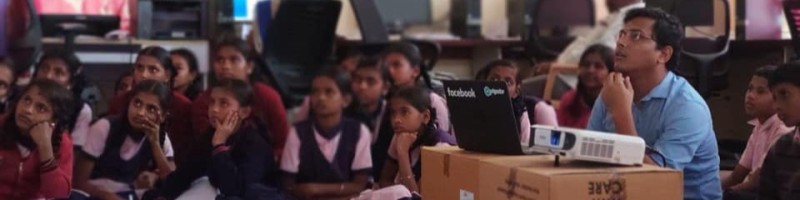
We have built a system that produces knowers, not learners
In a Class 3 students were unable to read the text expected for their grade level. The curriculum and teaching methods still emphasize rote learning and memorization over critical thinking, creativity, and real-world skills.
Read that again. Class 3. These are eight and nine year olds who have already spent years in school and three quarters of them cannot read at their own level.
This is not a failure of intelligence. It is not a failure of effort. It is a failure of method.
Students are often encouraged to memorize textbooks rather than develop critical thinking or analytical skills. This results in individuals who may have high academic scores but lack real-world knowledge and problem-solving abilities.
We have designed our schools around a single question: Can you remember what we told you?
We have never seriously asked the more important question: Do you know how to figure things out on your own?
What learning actually is — and what we mistake it for
Here is something I learned after years of working in classrooms across India, from tinkering labs in Ahmedabad to maker spaces in remote Amreli.
Most of us were never taught to distinguish between memorising and understanding. We were rewarded for the first and rarely given the tools to develop the second.
Memorising is temporary. It is useful for passing tomorrow’s exam. Understanding is permanent. It is what you carry with you into every situation you have never encountered before.
Real learning the kind that actually changes what you can do happens when three things come together. First, you encounter an idea that genuinely puzzles you. Second, you wrestle with it you try, fail, adjust, try again. Third, you connect it to something you already know. That connection is the moment understanding is born.
Notice what is missing from that process: a teacher telling you the answer. A textbook giving you the definition. An exam asking you to reproduce it.
The science of learning is an interdisciplinary area of study that investigates the processes of human learning. It provides an understanding of how people actually learn, which supports the design of pedagogies and tools that truly meet their needs.
We now know more about how the brain learns than at any point in human history. Neuroscience, cognitive science, and decades of classroom research have given us remarkably clear answers. And almost none of it has reached the average Indian classroom.
The five things that actually make learning stick
I want to share five principles that research consistently supports — principles I use in my own work with students and educators. These are not complicated. They are just rarely taught.
1. Curiosity first, content second.
The brain does not learn equally from everything it encounters. It learns far more deeply from things it is genuinely curious about. When a learner asks a question a real question that they actually want answered — something shifts neurologically. Attention sharpens. Memory strengthens. Connections form faster.
The implication for teachers is profound: before you teach the answer, create the question. Not a question from the textbook. A question the student actually cares about.
2. Struggle is not failure. It is the process.
One of the most damaging things we do in Indian education is rescue students from difficulty too quickly. A child gets stuck, the teacher explains, the child copies, the lesson moves on. Nobody learned anything deeply in that exchange.
Research on what cognitive scientists call “desirable difficulty” is clear: when learners struggle productively when the challenge is just beyond what they can currently do learning is deeper and more durable. Struggle is not a sign that something is going wrong. It is a sign that learning is happening.
3. Spacing and retrieval beat cramming every single time.
If you want to remember something for longer than a week, cramming the night before an exam is one of the worst strategies available to you. Spacing practice out over time, and repeatedly trying to retrieve information from memory rather than re-reading it, produces dramatically better retention.
We now know more about how our brains learn, and how to support learning, than at any point in human history. Modern educators have at their fingertips powerful insights from cognitive psychology and rigorous classroom research about how we can lift all learners.
These insights are decades old. The tragedy is that they have been slow to find their way into how students actually study or how teachers actually teach.
4. Connection is the currency of deep understanding.
Knowledge that sits in isolation is fragile. It is easily forgotten and even more easily confused. Knowledge that is connected to other ideas, to real experiences, to things you have built or made or tried is robust.
This is why hands-on learning is not just more fun. It is neurologically more effective. When a student builds a circuit, wires a sensor, designs a solution to a real problem in their community, the knowledge involved in that process becomes embedded in a web of memory, experience, and meaning. It is almost impossible to forget.
5. Reflection is what turns experience into wisdom.
Doing things is not enough. You can have a thousand experiences and learn very little from them if you never stop to ask: what happened there? Why did it work? What would I do differently? What did this teach me about how I think?
This practice metacognition, in scientific terms is perhaps the single most powerful learning habit a person can develop. Yet it is almost entirely absent from formal education in India.
What this looks like in a real classroom
I want to tell you about something I have seen happen, many times, in schools that most people would not expect to produce remarkable learning.
A teacher in a government school in Gujarat once told me that she had stopped starting her lessons with content. Instead, she started them with problems. A broken object. A puzzle. A question that had no obvious answer. She gave her students five minutes to just think or talk quietly, or try something before she said anything.
Her students, she told me, became different learners. They started arriving at school with their own questions. They stopped waiting to be told what to think.
What she had done, intuitively, was teach her students how to learn. She had not read a neuroscience paper. She had simply paid close attention to the moment curiosity appeared in a child’s eyes and decided to protect it rather than replace it.
That is the whole idea.
Why this matters more now than ever before
India has nearly 248 million school students studying in 15 lakh schools. And yet, rote learning has held back the country’s education system for decades. As a result, a majority of students in India’s smaller towns and cities feel unprepared for 21st century careers talented yet lacking in skills like critical thinking, problem-solving, communication and collaboration.
248 million students. That is not a statistic. That is a generation.
The world those children are growing into will not reward people who can recall facts quickly. Every fact in human history is now available in seconds on a device that fits in a pocket. What the world will reward — what it is already rewarding — is the ability to learn new things fast, to think clearly under uncertainty, to solve problems that have never been solved before.
By 2025, India would have the largest working-age population in the world. We are at that moment right now. The demographic dividend everyone talks about only pays out if the people at the centre of it know how to learn, adapt, and create. A population of 248 million students who have been trained only to memorize is not a dividend. It is a missed opportunity of staggering proportions.
What educators can do starting tomorrow
I am not writing this to criticise teachers. I have spent enough time in enough classrooms to know that most Indian teachers are working harder than they should have to, with fewer resources than they deserve, under systems that were not designed with their success in mind.
But there are things any educator can do, regardless of their school, their resources, or their syllabus.
Ask more questions than you answer. Give students problems before you give them solutions. Let them struggle a little before you rescue them. Ask them, at the end of a lesson: what confused you today? What are you still wondering about? How did you figure that out?
And perhaps most importantly talk to your students about learning itself. Tell them that their brain gets stronger when they struggle. Tell them that forgetting is not failure, it is part of the process. Tell them that curiosity is not a distraction from learning, it is the engine of it.
These conversations take five minutes. They change everything.
What I can do I started Tinkering India
I started Tinkering India because I believe India’s education story is not being told honestly or completely. The extraordinary teachers, the curious students, the schools doing remarkable things in impossible conditions they exist everywhere across this country. They just need a platform.
But I also started it because I believe the conversation about education in India needs to go deeper than infrastructure, funding, and policy as important as those things are.
It needs to reach the question that sits at the heart of everything:
Are we teaching children how to think? Are we teaching them how to learn?
If the answer is yes even imperfectly, even in one classroom, on one Tuesday afternoon, with one teacher who decided to start with a question instead of an answer then something important is happening.
And it is worth celebrating. It is worth telling the world about.
That is what we are here for.